A little of this, a little of that. Perhaps a lot of whining, perhaps a lot of arguing for truth and social justice. It will be what it will be.
Sunday, April 17, 2011
a less whiny post about bachelorette parties
Monday, December 27, 2010
The homelessness problem...
Tuesday, September 22, 2009
decisions, decisions.
My thought for today is that I either need to go back to Yoga or back to therapy. Maybe both. I'm not making a decision till after my holiday though. Thursday, April 30, 2009
the investigation is over!
Sunday, March 22, 2009
just an all around sad story
This is a story about death. This is a story about everyday life. This is a story about the poor and the middle class. This is a story about people struggling to get by. This is the story of inequality, unfairness and injustice. This is truth. Saturday, March 14, 2009
standing up for yourself
Something I've been trying to encourage my clients to do lately is to speak out. It seems like every day I'm hearing another story of injustice, and the abuse of my clients. It bugs me, and while I can, and do, speak out about it, I think they need to as well. I think not only is it more powerful coming from them, but I also think it can be very empowering. Sunday, February 22, 2009
Actions and Consequences

When I was a child, my parents taught me that there was a consequence to each of my actions, good or bad, and often, if I did the wrong thing, they were the ones to enforce the consequence. For example, leaving my room in a mess despite repeated warnings to clean it up might result in not being allowed to watch TV until it was clean. And more serious for me, my mom almost took my entire collection of books away because she caught me reading after lights out one too many times. As adults, there’s no parent standing over us handing down consequences, but that doesn’t mean they are no longer there. Bestest bud, for example, expected the house to be clean when she house sat this week and so because I hadn’t cleaned in ages I had to spend the two days leading up to my vacation cleaning like mad trying to make a dent in months of clutter.
Many people believe that the homeless are simply living out the consequences of their actions and because of that they do not need our help. Rather, they simply need to take new actions which will have more positive consequences. If unemployment led to loss of housing, finding yourself employment will then lead to housing. This way of looking at things looks at things on a more macro level and is easily generalized to many different situations.
On a micro level however we look at individuals, their situations, their actions and what the consequences of those actions are. It can become easy for my coworkers and I to take on a parental role (often quite unintentionally) and become the one who hands out consequences. A client does something wrong, we punish them. Sniff in the shelter, kicked out for 24 hours for example. One would expect this to be a deterrent, but if losing housing wasn’t enough to force someone to find employment will 24 hours outside force someone to stop sniffing? I think that’s what gets to a lot of us. We kick people out over and over and over and over again, and they’re mad, really mad, and yet month, or a week or even the next day, they’re doing it again.
One reason for this is addiction. Addiction is very powerful. I didn’t really just how powerful until I started working in detox. I hear people whose hearts are just breaking because of the horrible consequences of their addictions, who want more than anything to stop, and yet are somehow still held captive by their substance of choice. Further, after you use drugs/alcohol for a while your brain starts to go. You actually kill brain cells and damage parts of your brain, including your memory. Further you may not remember what happened as you “blacked out” from drinking.
Another reason is FASD and/or other brain damage. One of the frustrating things about working with children with FASD is their inability to understand the consequences of their actions. This is true for adults with FASD as well, only we expect adults to have mastered this concept. No matter how many times we tell someone, they may simply not get it (one of the reasons we tend not to use sliding punishment scales in which the punishment increases each time the action occurs).
A third reason people do not seem to learn from their consequences as we expect them to is mental illness, bet that depression, anxiety, schizophrenia or anything else along the spectrum. It’s hard to care about the consequences when you don’t exist in the same reality as the one who makes the rules. Sometimes a person can be so depressed they just don’t care, don’t care at all. Watching that can be scary, people with zero regard for their own lives are not only a danger to themselves but to those around them as well.
So, how then do we create a safe environment for all people?
Saturday, February 21, 2009
Situational Ethics: A Case Study

Jared is a man whose burned a lot of bridges, and when I say a lot of bridges, I mean it. Jared is not welcome, ever, at any of the other shelters in town, and has been permanently restricted from many of the hotels, medical clinics and rooming houses along the strip. There are not a lot of places left where Jared is able to go. He’s been given a lot of chances, but this physically disabled man has done A LOT of horrible things in his life, and he’s not even all that old. I mean, it takes soooo much to get yourself a lifetime ban from our services, and he did it.
Of course, it is always possible to appeal your ban, and so with the help of a hospital social worker, he did just that. See the thing is, when Jared isn’t drinking, or sniffing, or smoking crack or taking whatever the substance of the day is, he’s a nice guy! However, he’s one of the very few clients I am actually afraid of, very afraid of. See the thing is, staff have seen Jared sexually assault another client...but, since she didn’t press charges...
So, Jared’s back in. He uses our services just like any other client and gets the same punishments for drinking/using in the shelter as every other client, 24 hrs out. What happens when Jared sexually assaults another client, this time in the shelter, in front of witnesses and under a camera? What happens when the police say there’s not enough evidence despite the camera? There’s no charges, what do we do with Jared then?
Personally, I want to see Jared out. Out. Out. Out. Out. Out. But, as I said before, I’m scared of him, and I like to defend the little guy. Management doesn’t agree with me. Management wants him to sober up. See, the night of the assault, Jared spent the night on the street in frigid temperatures. He begged ambulances to take him to the hospital, he tried to assault police so that he could get thrown in jail. But no one would do anything for him. By morning, Jared was a freezing cold, sober, sad person who begged my coworker to let him back in, just to warm up... and how could we not? And then, then he said he didn’t remember a thing. He claimed to have to memory at all of anything until sometime in the middle of the night when we wouldn’t let him in (looking at this, even my language shows my bias).
So, what do you do in a situation like this? Because it is situational... if it was summer, or if he wasn’t disabled, or if he wasn’t kicked out of everywhere else, or if he acknowledged wrong doing, or if there was better evidence, or if there were charges, or if, or if, or if...
Living on the streets is not easy, it’s really not...
Friday, February 20, 2009
Situational Reactions (ethics)

One of the convenient things about having the drunk tank located half a flight of stairs away from the shelter is that when clients are intoxicated and behaving badly it’s very easy to have police or downtown watch who are dropping someone else of put them in there. For the most part they’re fine to do it and don’t ask a lot of questions, they simply trust us that they’re being disruptive and need some time to sober up. The thing is, that we of course do not have all clients who are not following the rules thrown in the drunk tank, and I was thinking about how the situation really determines our course of action rather than a set policy. Some people might even call this situational ethics...
The last person I had put in the drunk tank was not so much being loud as just unable to settle down. They were up and down (and all around) and despite repeated warnings, had not laid down to go to sleep. This person was just stupid drunk, not particularly violent or insulting, but I have to admit, they were just plain annoying. Factors which led me to ask the police to put them in there: It was a quiet night so the drunk tank was not anywhere near full, it was really cold out so I didn’t want to throw them out in the snow, they were keeping other people from sleeping, I thought it would be really good for them to have a chance to become fully sober before using again (see and that, is where my bias comes in, what I think). Another shift manager in my same situation might have simply thrown the person out, or, being more patient then me might have just allowed them to continue and given them some more chances until they sobered up enough to calm down.
So, what’s the right answer? When does having the drunk tank give us inappropriate power? As usual, I’m not sure there is an answer. I truly believe it all comes down to the situation. Other people might disagree with me, looking instead for a black and white answer, but I really don’t think there is a check list of things that mean someone gets kicked out, locked up, or allowed to sleep. That’s where experience comes in, and I often don’t feel like I have enough of it to be left in charge.
Thursday, February 5, 2009
self determination
I've noticed an interesting trend since I started working at the shelter. I suppose in reality I understood the theory of this, but I never really understood just how true it can be until I started working. Sunday, February 1, 2009
frequent caller
One of the things we try and work on at the shelter is cutting back on the number of 911 calls and wasted emergency room visits among the homeless. Studies of my city have shown that there is a group of homeless/mentally ill/both citizens make up an average of 1 in 7 visits to the downtown hospital and each one comes in an average of once a week; mostly for non-emergency situations. We try and help people find other ways to deal with their situations. Friday, January 30, 2009
Leaving the Shelter

Thursday, January 22, 2009
and sometimes it's so so so worth it

Monday, January 5, 2009
digging deeper - treating people as people

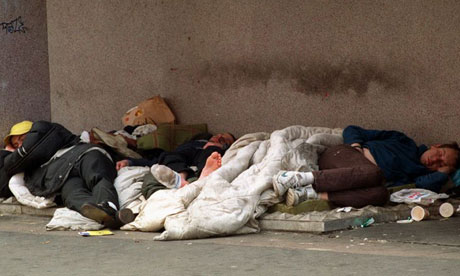
I'm not entirely sure why, but this photo evokes really powerful emotions in me. Tonight was my night off, and I spent some time working on a project for church. I was looking for photos which so a variety of different people from a variety of different walks of life and cultures. Seeing all the people reminded me that one of my intentions for the year was to see people as people and that got me thinking about my job.
It's all fine and well for me to say I want to remember that people are people, but I realized, when thinking about things, is that part of the way I cope with my job is to forget that, it makes things easier. Maybe that's good though, and maybe that's bad.
For example, when I have someone screaming and calling me unspeakable things (or at least things I won't publish here) it is much easier to think of them as "that intoxicated person" rather then give them a name. In fact, I generally refer to them as their cell number (interestingly enough though, i tend not to do that with clients I know well). Then there's example two, again, working the drunk tank. A girl sobbing, crying, begging me to help her, telling me of her horrible life, about the abusive relationship which wound her up here. So much easier to give quick reassurances and move on. Experience and practical reasoning has taught me that there's no use arguing or doing interventions with intoxicated people. In these situations, it's fairly easy to justify, whether that's good or not, I'm not sure.
Then though are the turn aways. It's really, really hard, to look someone in the eye, call them by name, and tell them they can't come inside the warm shelter when it's -30 outside. Exposed skin can freeze in less then 10 minutes, and what do I say? "I'm sorry sir, we're full, you have to get here early, we're usually full by 9PM". "I'm sorry, all the shelter beds in the city are full, you'll have to figure this out for yourself". Those, and other things, but generally those. Nothing can prepare you for that, and it's so much easier for them to remain Jane and John Doe then to dig deeper and ask their names, and how they wound up at your door that night. For some, especially the 2:45 crowd, it's simply that the bars don't close till 2:30, but for others, there are most deeper issues and we're their last hope.
So what I need to work on finding, as I've said many times before, is balance. A little pain keeps us moving, it's what keeps us fighting for change. Making things too black and white, and blocking out the suffering of people hardens us, and getting harden to far makes us, well, hard. I don't want to be like that. I also don't want to be the girl who runs to the bathroom and cries after each turn away (for the record, we don't have one, I just don't want to become one).
something to ponder as I fall asleep, what is it that dehumanizes people, is it our actions or our attidudes, must it be one, the other, or both?
Friday, January 2, 2009
examining evil aka examining my biases
There's one client who for a long time I was scared of, petrified of even. Ever since I started working on the side of the tracks where he makes his home, I've been scared of him. He's the kind of person who has a reputation in the neighbourhood. He's the kind of guy who throws rocks at cars during rush hour on busy streets. He's the kind of guy who rapes intoxicated women; where people can see him. I could go on for hours, but I think it's sufficient to say he's the kind of guy who just inspires fear in those around him.
So how does this relate to me. Well, a month or so back I was cruising around in the van with a coworker and we were talking about said client, Gavin, and I mentioned that I felt like he represented pure evil. My coworker agreed and from then on that's how I thought of him. Over time I've defended him to other coworkers saying he must have a lot of hurt in his life to have so much anger which comes out in so many ways, but still, this guy to me just seems so... horrible.
Of course I continued thinking, and I got curious and one quiet night I sat down and read through his entire file. It took quite a while, but as I read through the short entries over the course of ten years I began to piece together pieces of his recent history as well as get a sense of what made him into the angry adult he became. This man has had horrible things happen to him, things that shouldn't have to happen to anyone. He was born into a bad situation to start with, and history took a tole upon his future. His life was rampant with drugs and addiction, things he still struggles with today.
And see that's the thing. Gavin is the most scary when he's been using. When he's sober, it turns out he's a pretty nice guy. It kind of freaks me out, the juxtaposition of the two characters. And who knows, there very likely could be some kind of dissociation going on, the two people are just so different. One is this screaming person who throws tables and the other a nice, quiet, polite man who has serious health problems he is quite conscientious about taking care of. It's hard to evaluate someone abusing multiple substances for dissociation, and that's if anyone would even care to try.
So what I realized, is that you can't put people into boxes. I've always known this, I'm not a black and white person, but in this case, I was very black. Evil. Plain and simple. But the thing is, life is never that simple.
Friday, December 12, 2008
when bennie won't bathe
I’m getting sick of smelly people, and especially sick of the smell of urine soaked people after they’ve been drinking mouthwash (but that’s just a personal thing). In the spirit of change however, I’ve decided that instead of just whining about it, I need to do something about it. Whether or not my approach has been empowering however is up for debate.
In example one is the story of Adam who we met last entry. We gave him a wash cloth to sponge off and some clean clothes. While his clothes were no longer smelly, he really hadn’t got all that clean.
The next example is Ben. Ben also left the drunk tank covered in urine. In his case, I decided to point this out to him. We have a good relationship, so a gentle, "Ben, you're starting to smell, if I find you some clean clothes will you have a shower"? seemed like a good approach. And it was... in some ways. Ben and I spent time talking about how his life had gone down hill with is recent episodes of binge drinking and how he used to be so well dressed all the time. I consulted with him about the clothes I was picking and even found him a nice new winter jacket. Ben promised me that when he came inside for coffee he would collect his stuff and have a shower. The problem is, Ben never followed through, and he's out their somewhere, likely in the same dirty clothes.
And then, there's Chris. Chris is my one "success" story. With Chris, I was simply very directive. We again have a good relationship built and it's okay for me to do this. Besides that, I would listen if the client said absolutely not. Basically, when I opened his drunk tank cell I had already gathered all the shower stuff needed and simply walked him upstairs and into the shower. "Chris, it's time for a shower, I've got some clean clothes for you, just follow me upstairs and I'll open it for you". Once at the shower, I gave instructions to wash hair and body, brush teeth and comb hair, as well as to throw out the old clothes as they smelled. Chris, had a shower (Chris also invited me to come have a shower with him).
See the thing is though, I'm not usually so directive, but sometimes it gets to a point... Further, there's the fact that enforcer was totally on board with my plan which makes me wonder, just cause we don't normally agree... I guess it's not something I would do often, but I think almost all of us at work have done it. Sometimes people just really need a bath... or do they?
Friday, November 28, 2008
non sensical ramblings about homelessness (part 6)
It's interesting not being in school. I no longer am forced to really examine my thoughts, feelings and biases about things on a regular basis. In some ways that feels really nice, but in other ways I feel like I'm kind of losing out. I've been thinking a lot lately, and it's interesting some of the assumptions I make, even though I "know" better. And it's interesting how in some situations I can be very black and white, where in others I'll bend the rules no problem.
One of the things I feel very strongly about is that when the shelter is full, the shelter is full. I do not feel like we should be squeezing extra people in to sleep on the floors and under the sinks and stuff. Besides, somehow, no matter how careful we are, there always seems to be extra people in the shelter who are not entered in the computer. Therefore, when we're full, we're probably already at least 5-7% over capacity. Letting in another 10% more people means we may be operating at almost 20% over capacity which if you asks me is a huge safety risk and health hazard. We tell late comers that they need to come earlier; over and over and over again. Some of the staff will let them in to squish (the enforcer being one of them, interestingly enough) where as I will make them stay outside in the cold. We're full, we're full. Often the enforcer lets them in as soon as I turn around, which also bugs me.
One of the assumptions that I make though is about actions and consequences. For me, it seems like getting locked out of the shelter is the natural consequence of coming too late. But are people understanding that? Because they do it time and time again. Or to people see it as me being cruel? That's the other thing, if you ask me, I'd say that shelter is a basic human right. At the same time, in society we live with a capitalist world view, and some would say that these people are not entitled to shelter. It's horrible, but sometimes I just feel like screaming "go get a freaking job"! Today when two people were guilt tripping me at the window and said "well then find us a place to stay". I said "if you're interested in looking for more permanent housing, like a house or something, you can talk to one of the staff in the morning"... they were speechless, they looked at me like I was crazy, and then turned and walked away.
But the thing is, some of our clients do find housing, and what boggles my mind, is that almost all of them do it by themselves, without our help. One day they're with us, next day their gone, and we find out that they've gotten themselves a place. Often they get evicted and are back in a couple months, but at least for those two months they have something that's "theirs". Another thing that is a huge value statement. In society, we value what belongs to us, we value possessions and individual ownership, who am I to say that housing is the "right" answers to the homelessness "problem". In my city, social assistance gives funding to people for housing, and per diem rates to our shelter. It's the same person paying no matter which place they stay.
Another thing we really value is personal responsibility. One of the other feelings I hide, is the feeling that many of our clients are simply not taking responsibility for their lives and actions. It makes me really mad, when they drink, and use drugs all day (evening) and then expect us to come up behind them, give them a place to sleep it off, give them food, and in general, care for them. And yet, I also feel like that's what we should be doing, giving people unconditional positive regard. Giving people a chance, and accepting them for who they are. That's basically why I became a social worker in the first place.
Like I said, I'm quite mixed up right now about things. Every now and then I think we all have those moments where everything we believed in and everything we think we know falls apart before our eyes and we have to pick up the pieces and put it all back together again.
Thursday, November 13, 2008
feeling safe
For most of us, it's hard to picture why anyone would want to live in a homeless shelter, especially one like the one I work at. It's not exactly the nicest place to spend the night. A mat on the floor, right next to the people on either side of you, bathrooms with no locks, people drinking mouthwash in the backroom (yet we never seem to catch them in the act), scabies, lice, urine, feces, tb, hiv, dirt, crumbs, yuckiness, and yet, this is home.
The thing is though, many of the people have lived through hell all ready. They've been in residential schools, abusive alcoholic homes, foster care group homes, nights spent literally on the street. We have a safe, loving environment, we're consistent, we have clear rules and expectations, there's always food and water, someone to talk to, friends nearby and a ride to the hospital when they need that extra bit of caring we can't provide.
Low income housing can be scary, dangerous, and well, a lot dirtier then the shelter which gets disinfected twice a day. The going rate for housing on welfare is laughable. There is NO way to get anything for that amount of money other then a monthly rate in a hotel room where you have to share a bathroom and have no kitchen. These hotels survive entirely on welfare customers who have no where else to turn and get away with A LOT. And they can evict a person with no ramifications because there are always more where that person came from!
The other kind of housing which can be found are rooming houses and apartments run by slum lords. To live in one of these kind of places, a person either has to be part of a couple, or take from other parts of the welfare budge to make the rent, and on a small budget, 75 dollars taken away from food is a lot of money. These rooming houses are often crack dens, a crash spots for people sleeping off their night of partying. Again, there are shared bathrooms and either a shared kitchen or no kitchen at all. In some of them, you actually have to share a room. Apartments are often poorly or not heated, have no functioning appliances, roaches, bedbugs, mice, rats, and filth.
So, when a person says they feel safer and better sleeping at the shelter, I really can't blame them. It's hard, but I don't think in my city we'll be able to get people off the streets until we create somewhere better for them to go to. Finding a "place" is one thing, finding somewhere to call home is very different.
Tuesday, November 4, 2008
macaroni and cheese
I fully intend this post to be (at least slightly) more coherent then the last one!
This week when I was volunteering we had a really great group in helping us, so I took the time to actually eat with one of our guests, someone who also stays regularly at the shelter. It was great to actually be able to sit down and spend time with him, to just listen, and to share a meal together. I learned A LOT about him, far more then I would have in a month of just seeing him in the morning for coffee at work. This is one of the advantages to volunteering with the same population I work with (of course there are many disadvantages too).
It was a good meal, but what I found interesting was his attitude towards the food. When we were done eating, he wanted to wrap up his leftovers (pretty normal) and mine (okay, well, makes sense). What was odd though, was his reason why, or at least I thought so. Rather then sighting the fact that he was hungry, and might be hungry later, he had a strong belief that he needed to eat everything on his plate because there were children starving in Africa. This is an elderly homeless man, and he was quite worried because of the commercials he saw on TV about children starving far away.
It makes me wonder where he developed that view. Because honestly, I don't think he was watching TV one day and was like "oh, they're hungry, I should eat everything on my plate". I think it's far more likely he learned it in residential school. It was in these schools that Canada's aboriginal people were forced to learn white/european values, and quite effectively stripped of their culture. It's interesting also, because in the midst of his extreme poverty, this man is able to look beyond himself and realize that there are other people in just as bad if not worse circumstances, something which a lot of my clients cannot do.
All in all, it was a good meal, and the macaroni and cheese did taste very good. Eating it with my client/our guest just made it taste all the better.
Monday, October 13, 2008
confidentiality
Confidentiality. All through school I've had it drilled into me. Confidentiality, confidentiality, confidentiality. And when are the times you can break confidentiality?
- Threat of harm to self
- Threat of harm to others
- Abuse of a child
And that's it. You can't just go around breaking people's confidentiality for other reasons. This is where the enforcer and I disagree.
The situation is this. We have someone in detox who may know some more details about how a woman died (I wrote about her a few entries ago, she was found on the street, gone). It may be that someone pushed her down the steps. During his detox intake he disclosed it to the worker (we're called "crisis workers") who shared it in shift change.
Now the enforcer seems to think that we have a duty to report this to the police and I disagree. I say we have to respect people's confidentiality and that all we can do is encourage this person to report it.
Unfortunately, that is not what came out of my mouth though, and here's where I created my entire problem which lead to our entire fight, and I should have known better. I said something like, "as I social worker the only time I can break confidentiality is - see above". This is when the lecture started. The lecture about how I'm not a social worker I'm a crisis worker, and I can't say I'm a social worker while I'm working because I'm not. I say I'm I social worker wherever I am. That I am a registered social worker and breaking people's confidentiality like that could make me lose my registration with my professional institute.
The enforcer starts getting really mad, tells me that it doesn't matter. That I have to follow agency policy, which is to report things (since when?), and that I'll be prosecuted if I don't. He has me cornered, yelling at me, and my supervisor (who I love) jumps into it too, telling me I'm not a social worker there and I have to follow policy. The enforcer won't let me speak, keeps telling me I'm interrupting, so I let him have his thing. Then when I want to have a turn, he won't let me speak, and goes on about how hard I am to work with. This is when I exit to go the bathroom and cry.
When I'm semi calmed down, I go back upstairs and say "Okay, I'm taking into consideration what you said, I'll talk to our boss and my professional institute and work this out. I'm new at this whole social work thing, and still have a lot to work out". I go about my work, getting on my knees to fill up some sugar. The enforcer stands over and yells some more. I keep crying and remind him "I don't want to talk about it". "Why would you want to talk to our boss, don't talk to him". I tell the enforcer that if that's the policy I'll quit, because one job is not worth losing my registration over, and then the enforcer, my supervisor and I get into it again. I'm basically ready to quit my job on the spot, except it still seems like a really far fetched policy, and well, I like my job. a lot. So I leave. But just to go pick up some donations. It takes me an hour of driving, a clonazepam (klonopin) and some yoga breathing in a random parking lot, but by the time I come back, I'm actually mostly calmed down.
In the morning, I talk to my boss about it, first thing. Not the fight exactly, just what the policy is. Turns out, the policy is exactly what I wrote at the very beginning. My boss says "we're not the justice system, we'll never have any trust with these clients if we tried to be". So I was right, but it really doesn't feel very good at all, and I'm not planning on telling the enforcer that, why bother. I want to sit down with him and talk it out, but I don't think it's going to happen, at least not yet.
A collegue got to work the next day and already knew about our fight, how, they'd run into each other and the enforcer mentioned "I made still dreaming cry last night". Oh, so this is a point of bragging now? If I didn't love my job...